
Mullein Glycerite Recipe: How To Use Mullein For Coughs & More

If you want a convenient way to use mullein for coughs, you can’t go wrong with this mullein glycerite recipe! It’s kid-friendly and simple to make.
As an herbalist, mullein leaf reigns supreme as my top respiratory supportive herb. I’ve seen it do amazing things for my family, loved ones, and clients.
My favorite way to use it is in an herbal tea blend. But sometimes, tea just isn’t practical or convenient.
Thankfully, there’s an easier way to use mullein for coughs and other health needs. It’s this homemade mullein glycerite recipe, and it’s simple enough you can do it no matter how much herbal experience you have!
It’s Like Hostage Negotiations
As a mom of 9, I’ve seen my share of childhood coughs, colds, and stuffy sniffles. And as I grew in herbal knowledge, I became more comfortable supporting my kiddos through their respiratory illnesses with herbs.
But inevitably, there’d be that one child who refused all the herbal remedies no matter how miserable he or she was feeling. Tea especially. Apparently hydration is too difficult when you’re a sick youngster
“Do you like coughing and being so stuffy?” I’d ask.
“No,” they’d say.
“This tea will help you feel better!” I’d plead.
They’d disagree.
When negotiations like this take place, you have to have something more convenient in your arsenal.
Something that goes down quickly, tastes great, and doesn’t require you to do any extra work when your child’s already extra needy and your patience is running low.
This is why I love mullein leaf glycerite.

Mullein Leaf: A Gentle Respiratory Powerhouse
Mullein (Verbascum thapsis) is a wild herb that grows readily all over the United States and other temperate parts of the world. Its leaves, flowers, and roots offer all sorts of health benefits. I consider it a must-know herb.
And while I’ve tinkered with the root as a tincture and enjoyed the flowers infused in oil, I turn to mullein leaf anytime a respiratory need pops up. It’s hard to beat mullein for coughs, colds, and congestion!
- Mullein leaf is a respiratory tonic, so you can use it for longterm respiratory system support.
- It acts as an expectorant, thinning mucus and making it easier to expel.
- It has antispasmodic actions, so it helps relax stubborn coughs that make it hard to rest.
- As a mild lymphatic herb, it supports good lymph flow and drainage.
- It moisturizes and soothes dry, inflamed tissue like sore throats and tight, achy lungs.
- Mullein leaf also offers gentle astringent actions, so it tones tissue that feels heavy with fluid.
- It’s mildly relaxing, making it a great herb for anyone who doesn’t feel well.
As you can see, mullein leaf brings a lot of balance to the body, and especially the respiratory system! And since it’s such a gentle herb, you can feel confident using it with children and adults.
The Best Way to Use Mullein for Coughs & Congestion
As I mentioned earlier, my favorite way to use mullein for coughs, colds, and other respiratory concerns is as a tea. I like to mix it with other herbs that fit the specific situation I’m facing, such as blending it with aromatic herbs to help open up airways.
Teas give your body the extra hydration it needs anytime you’re sick and dealing with inflamed tissue, like a sore throat. They can help relax coughing and are a cozy thing to sip when you don’t feel good.
But young kids aren’t great about drinking tea. Even when I try to convince them it tastes good and that the tea will help them feel better.
And, let’s be honest, some adults aren’t crazy about drinking herbal tea, either.

You can buy or make mullein leaf tincture to get many of mullein’s respiratory benefits in a quick dose. But tinctures aren’t usually tasty, and that can be a problem for some people.
So I started making mullein leaf glycerites to support my own kiddos when they came down with coughs and congestion. I had hoped a kid-friendly mullein extract would work as well as a tea and go down easier.
It’s been a success! Now I make a batch of my mullein glycerite recipe every year or two so I always have it on hand.
Glycerin: The Kid-Friendly Herbal Solvent
Before we get to the mullein glycerite recipe, you might wonder what vegetable glycerin is and what it does.
Vegetable glycerin is a sugar alcohol derived from oils and fats. In commerce, you’ll mostly likely find vegetable glycerin made from soy, coconut, or palm oils.
Like other sugar alcohols, glycerin tastes very sweet. Many experts believe it doesn’t spike blood sugar, but there’s mixed information out there for how glycerin might affect diabetics. So if you want to use it as a sugar substitute, do some additional research to see if it’s a good fit for you.
Glycerin is humectant, meaning it attracts water and moisture to itself. That’s why you’ll often find it in body care products and cosmetics. People also use glycerin in soap making and cooking.

In herbalism, though, we use glycerin to make alcohol-free herbal extracts called glycerites.
Some people refer to glycerites as alcohol-free tinctures, but a tincture is defined as an alcohol-based herbal extract. It’s more accurate to call these glycerites and skip the word tincture altogether.
Glycerin-based herbal extracts are perfect for kids because of their sweet, mild taste. In fact, most commercial herbal extracts formulated for kids are glycerites, rather than traditional tinctures.
Glycerites are also great for people who don’t tolerate or want to use even small amounts of alcohol. If someone is pregnant, has religious objections to alcohol, or has a history of alcohol abuse, glycerites are a great option for them.
Tips for Making a Better Herbal Glycerite
So if you can use glycerin to make herbal extracts, and it actually tastes good, why would anyone want to make alcohol-based tinctures?
Well, glycerin has two major shortcomings.
- It isn’t as shelf-stable as alcohol, so glycerites are best used within a year or two.
- It’s a weaker solvent, so the glycerites aren’t as potent as tinctures.
But there are a few things you can do to make a better glycerite and help offset some of glycerin’s flaws.
- Grind up your herb very well. You can do this in your blender like I’ll explain for this mullein glycerite recipe, or you can use a food processor, coffee grinder (for dry herb), or old fashioned mortar and pestle.
- Heat your glycerite while it’s macerating (that’s herb-speak for an herb infusing into a solvent). I do this for a few days in a slow cooker before I strain the glycerite.
- Consider adding a little alcohol for better shelf-stability and a stronger extract. It doesn’t take much, but it can make a big difference.

Also, be sure to buy food-grade vegetable glycerin. Some glycerin is for topical use only. I prefer certified organic, as well. If your glycerin is palm-derived, look for sustainability efforts on the packaging.
These tips will make sure your mullein glycerite recipe turns out great, as well as any other glycerite you make in the future!
How to Make a Mullein Leaf Glycerite Recipe
Since glycerites have a short shelf life, it’s best to make smaller batches that you replace every year or two.
For this recipe, you’ll end up with around 8 ounces of mullein leaf glycerite. If you have a big family like I do, you might opt to double it. And if you live alone or with just one other person, half the recipe might be perfect for you.
As you’ll see, making this mullein glycerite recipe doesn’t take any special herbalist skills. It’s very similar to making tinctures, like my cleavers tincture and echinacea tincture. If you can use a blender, kitchen scale, and measuring cup, you’ve got what it takes!
Disclosure: The following sections contain affiliate links. If you purchase through these links, your cost is the same while I can earn a commission. Thanks!
Like working with herbs?
You’ll love The Herb Study Notebook!
Discover a simpler way to know your herbs inside and out and keep all of your herb learning in one organized, easy-to-use place.
Numbers Don’t Lie
While you can eyeball your ingredients, I prefer measuring extract ingredients by weight and volume. This helps ensure I end up with an effective, shelf-stable, and consistent remedy.
So for this mullein glycerite recipe, you’ll measure your leaves by weight, using a basic kitchen scale, and your glycerin by volume, using a glass measuring cup. Some basic math skills to pull it all together.
I prefer to use fresh herbs for glycerites as much as possible. Since glycerin attracts water, I feel the final glycerite is stronger with fresh plant material that still has all of its water content.
If you need help harvesting the best fresh mullein leaves, you can learn how to harvest and use mullein here.
With fresh mullein leaves, I use 1 gram of fresh herb for every 2 milliliters glycerin. This is a 1:2 ratio.
To end up with around 8 ounces of finished mullein leaf glycerite, you’ll start with
- 90 grams chopped fresh mullein leaf
- 180 milliliters food-grade organic glycerin
Put both ingredients in a blender and get ready for the next steps.

Optional: Boost the Shelf-Life & Extraction
If you want to make your glycerite completely alcohol-free, you can skip this step. But if you don’t mind a small amount of alcohol in the finished extract, here’s what I do.
Add a small amount of vodka or other neutral alcohol. You just need 1 teaspoon to 1 tablespoon, depending on who will take the glycerite.
Since I use 100% organic ethanol in my tinctures, I opt for a teaspoon or so. If you’re using 80-proof vodka from the store, you might go closer to a tablespoon since there’s less alcohol in it.
There aren’t hard rules here, so don’t overthink it. You’ll hardly notice the alcohol in the final glycerite.
Blend, Mash, & Macerate
Now it’s time to let your blender do its thing. Add the blender top, turn it on low or medium, and let the leaves and glycerin blend until it looks like a thick mash.
You might need to pause the blender now and then to push down any mullein leaves that creep up the sides.

Then transfer the herbal mixture into a pint-sized or slightly larger jar. Put a nonreactive lid on the jar and label it with the remedy name, ingredients, ratio, and date started. So for this mullein glycerite recipe, I’d label it:
Mullein leaf glycerite; 1:2 fresh leaf, 100 glycerin + 1 teaspoon alcohol; start date here.
The “100 glycerin” is shorthand for 100% glycerin. It reminds me that I didn’t add any water to the glycerin.
Next, put the maceration somewhere away from direct heat and light, but also in a place you’ll see now and then. Shake it every few days and allow it to macerate for 4 weeks or so.
Add a Little Heat
When your mullein leaf glycerite is almost finished, it’s time to add a little heat to it.
Gentle heat will help any final herbal constituents to make their way out of the mullein leaf and into the glycerin solvent. I heat the glycerite in the same way I heat my herb infused oils.
Just add some water to a small slow cooker. Place a cotton dishcloth or rag at the bottom, then place the glycerite jar in the cooker. You want the water to come up the sides of the jar, but not touch the lid.
Set the cooker on low and allow it to gently warm for 1-3 days. Add more water as needed.
Use Your Muscles (or Not)
After your mullein leaf glycerite has warmed in the slow cooker, it’s time to strain it!
When you first measure out the glycerin, you’ll notice that it’s quite thick, sticky, and viscous. After it macerates with the fresh herb, though, it’ll be thinner thanks to the herb’s water content. This makes it easier to strain.
Warm glycerites strain more easily, too, so I recommend straining it shortly after taking the jar from the slow cooker.

You have a few options for easy straining.
- Pour the mixture into a metal mesh strainer lined with layers of cheesecloth. Let the glycerite drip through, then use your muscles to squeeze out as much glycerite as you possibly can by hand. As my friend Steve says, “Squeeze it like it owes you money.” I think this counts as resistance training.
- Rather than squeeze by hand, use a potato ricer to squeeze out the glycerite after you let it drip through the metal mesh strainer lined with cheesecloth. Keep the cheesecloth around the herbal material when you add it to the potato ricer or you’ll end up with an herbal mashy mess everywhere.
- Invest in a heavy duty tincture press. This only makes sense if you make a lot of herbal extracts and want to do it forever. But I love mine!
The most important thing with straining your mullein leaf glycerite is to make sure no herbal material gets into the finished product. Mullein leaf is covered in tiny hairs, and these can irritate your throat if you end up ingesting them.
Final Touches
Once your glycerite is strained, it’s time to bottle and label it!

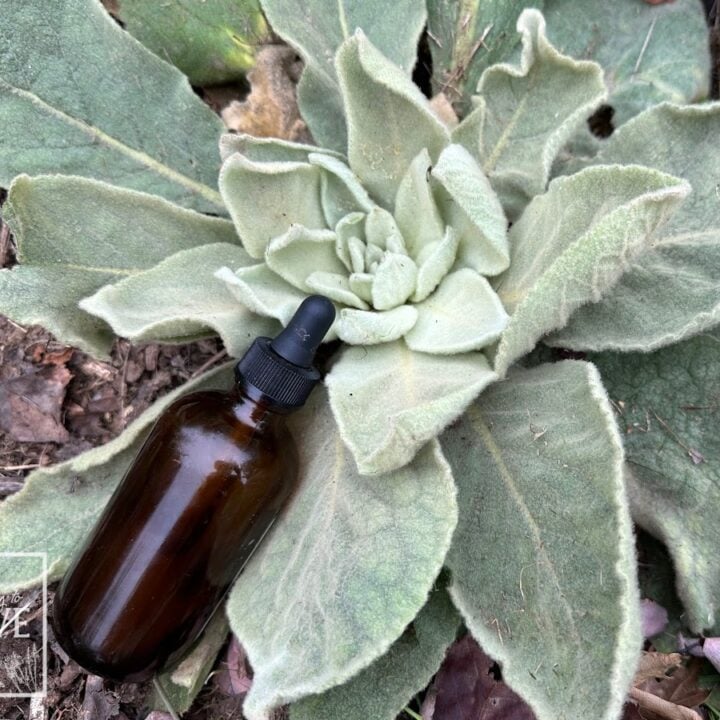
You can use any glass container for your glycerite, like canning jars or apothecary bottles. For the sake of easy dosing, you can simply use 2 4-ounce dark amber glass bottles with dropper tops.
Label your bottle or jar with all the information that will help you use your mullein leaf glycerite with confidence. I usually take my original label and simply add the date strained and any dosing guidelines I want to remember.
To dose your mullein glycerite, you can give kids and adults ages 2 and up 1 dropperful for every 30 pounds body weight. You can do that hourly until their symptoms reduce, then reduce to 2-3 times per day until the symptoms are resolved.
You can use mullein leaf glycerite along with other immune system supportive remedies, like elderberry syrup and fire cider. Most kids also love elderberry syrup and adventurous ones enjoy fire cider, too.
Mullein leaf is generally safe for all people, so it’s unlikely you’ll see any negative reactions or side effects from your finished mullein glycerite recipe.
Mullein Leaf Glycerite Printable Recipe Card
Mullein Leaf Glycerite
This fresh mullein glycerite recipe is a convenient and kid-friendly way to use mullein for coughs, colds, and congestion.
Materials
- 90 grams fresh mullein leaves
- 180 ml food-grade organic vegetable glycerin
- 1-3 teaspoons vodka, optional
Tools
Instructions
- Add the mullein leaves, glycerin, and vodka (if using) to a blender. Blend on low to medium until everything is combined into a thick paste.
- Put the herbal mash in a pint-sized jar. Add a nonreactive lid and label the jar with the remedy name, ingredients, and date started.
- Place the jar in a place away from heat and direct sunlight. Shake it every few days for 4 weeks.
- After 4 weeks, place a cotton cloth at the bottom of a small slow cooker. Place the glycerite jar inside and add enough water to come up the sides of the jar and below the lid. Put the slow cooker on low and let the glycerite mixture warm for a few days. Add more water to the slow cooker as needed.
- Remove the jar and allow it to cool for 5-10 minutes.
- Line a metal mesh strainer with a layer of fine cheesecloth. If your cheesecloth has an open weave, use multiple layers. Pour the glycerite mixture into the cloth-lined strainer and allow it to strain through into a measuring cup.
- Squeeze out any remaining glycerite by gathering up the cheesecloth and squeezing by hand, or squeezing in a potato ricer.
- Pour the glycerite into your dark amber glass bottles or other glass container. Label it with the remedy name, ingredients, date finished, and any dosing guidelines.
Notes
- If you use a lower proof alcohol in your glycerite, you can use 3 teaspoons. If you have a higher proof, you can use less. The alcohol improves the shelf stability and extract strength.
- Adults and children ages 2 and up can take 1 dropperful of extract for every 30 pounds of body weight. This dose can be repeated hourly when symptoms are severe, then reduced to 2-3 times a day as symptoms improve.
Now, when my young children have a cough or sore throat, I hardly even bother with mullein tea. Chances are, it’ll be a battle to get them to drink enough.
But after one taste of this mullein glycerite recipe, my hostage negotiation efforts end.
They know it tastes good. I know it’s good for them. They gladly take it, and we both win!
Your Turn
What’s your experience with glycerites?
What amount of dried mullein would you use?
Hi Clare. For dried mullein, you have to use a slightly altered process. You’ll extract using a 1:5 ratio (meaning 1 gram dry mullein to every 5 milliliters liquid solvent), instead of 1:2. You also need to add some water to the glycerine since your mullein isn’t fresh. I generally do 70% glycerine and 30% water, adding a bit of alcohol like I do for fresh herb glycerites. So for example, let’s say you have 40 grams dry mullein. You’d use 200 milliliters liquid solvent, made up of 140 milliliters glycerin and 60 milliliters water, plus a teaspoon or so of highest-proof vodka/ethanol you can find. Heat will help extract this type of glycerite. Hope that helps!
Thank you for sharing this recipe Kristen! I was thinking of making a syrup today, for my own stubborn cough. I have plenty of dried Mullein, harvested this year, none fresh. I was thinking to add some Hyssop for its antibacterial benefits. But, as much as I always go long and slow with extracts and infusions, I was hoping to find a recipe for Mullein syrup that I could immediately slow cook (below 95 on my keep warm setting in the crockpot, or alternating between keep warm and low, taking off heat once the temp reaches 115) Do you think that temperature would degrade the herbs? I’ve never used a dehydrator for drying herbs; usually either hanging to dry in a dark room with good airflow (fans on low setting) on laying flat on screens, depending on the herb and how she dries best/greenest. I do understand the importance of time especially for herbal remedies. However, I thought that since my Mullein is already dry, it may work to cook the glycerite low and slow. And would I need to add water, to better extract the mullein into the glycerin? I can make a tea, of course, but the thought of a syrup was intriguing and when I found your recipe I had to learn more.
Hi Patricia! If you need a quick mullein recipe, I’d suggest making a more traditional syrup. For that, you’ll make a strong infusion (herbal tea), then reduce it by half by simmering on the stove. Finally, you can either add an equal amount of raw honey, or an equal amount of sugar to make the syrup. Store in the fridge. The honey/sugar acts as a preservative.
A simple mullein and hyssop tea is wonderful, too.
You can’t make a strong glycerite in a few days, even when adding heat. You really want the herbs to macerate (infuse) for weeks.
I hope this helps and you feel better soon!
Hi, thanks so much for all your information! I have a question. When making a glycerine tincture is it not necessary to add water if using fresh herbs? I can’t seem to find a consistent answer. Thanks so much!
Hi Sarah! You don’t need to add water with fresh herb glycerites because the plant material itself is mostly water. When it extracts into glycerine, the plant’s water content gets pulled out into the final solution. Does that help?